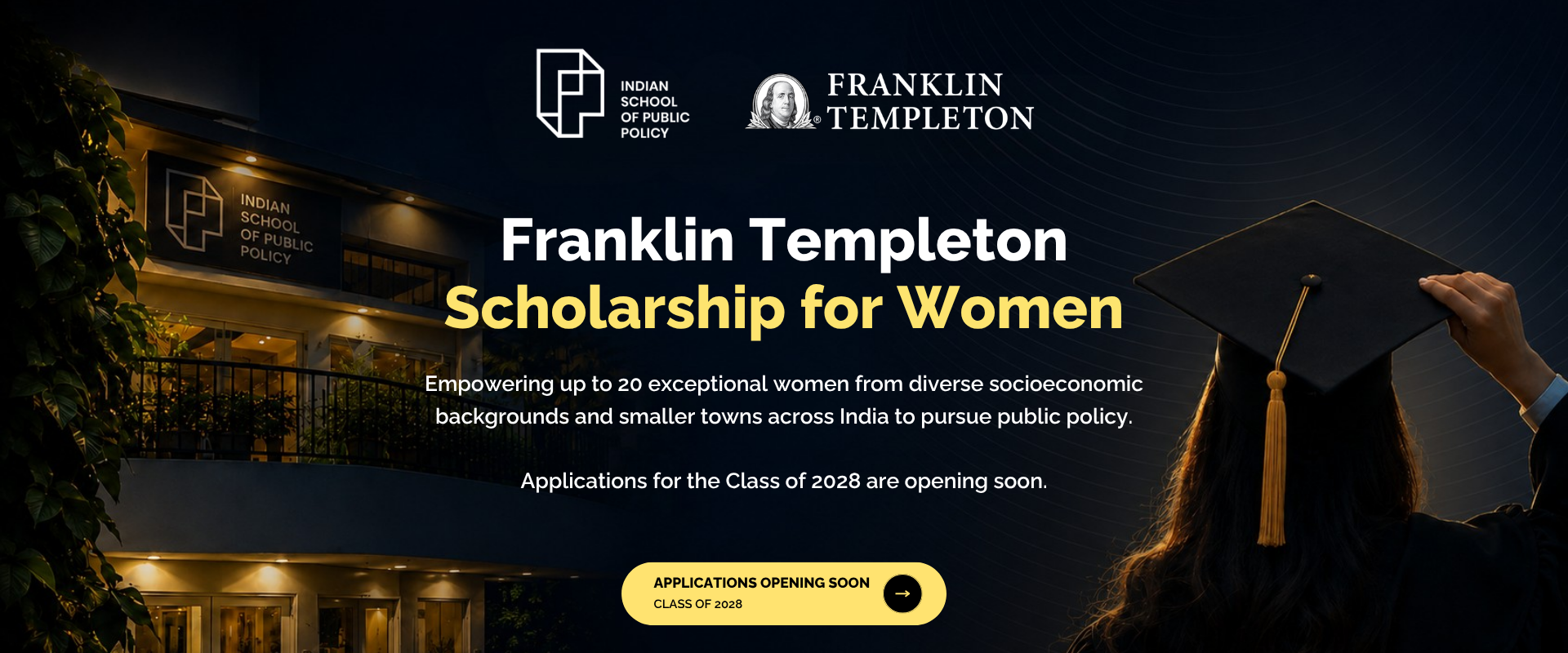
ISPP offers a dedicated initiative empowering women from Tier-2, Tier-3, and Tier-4 cities. Through this partnership, up to 20 selected scholars receive full or partial tuition support for the one-year PDM programme, along with access to mentorship and leadership opportunities.
Network with leaders across consulting, corporates, government, and non-profits for high-impact pathways.
Save time and cost with an accelerated programme blending policy, management, and design thinking-globally relevant, locally grounded.
Merit cum need based financial support ensures access to world-class education for all deserving candidates.
Hands-on internships and dedicated placement assistance across governance, development, and consulting.
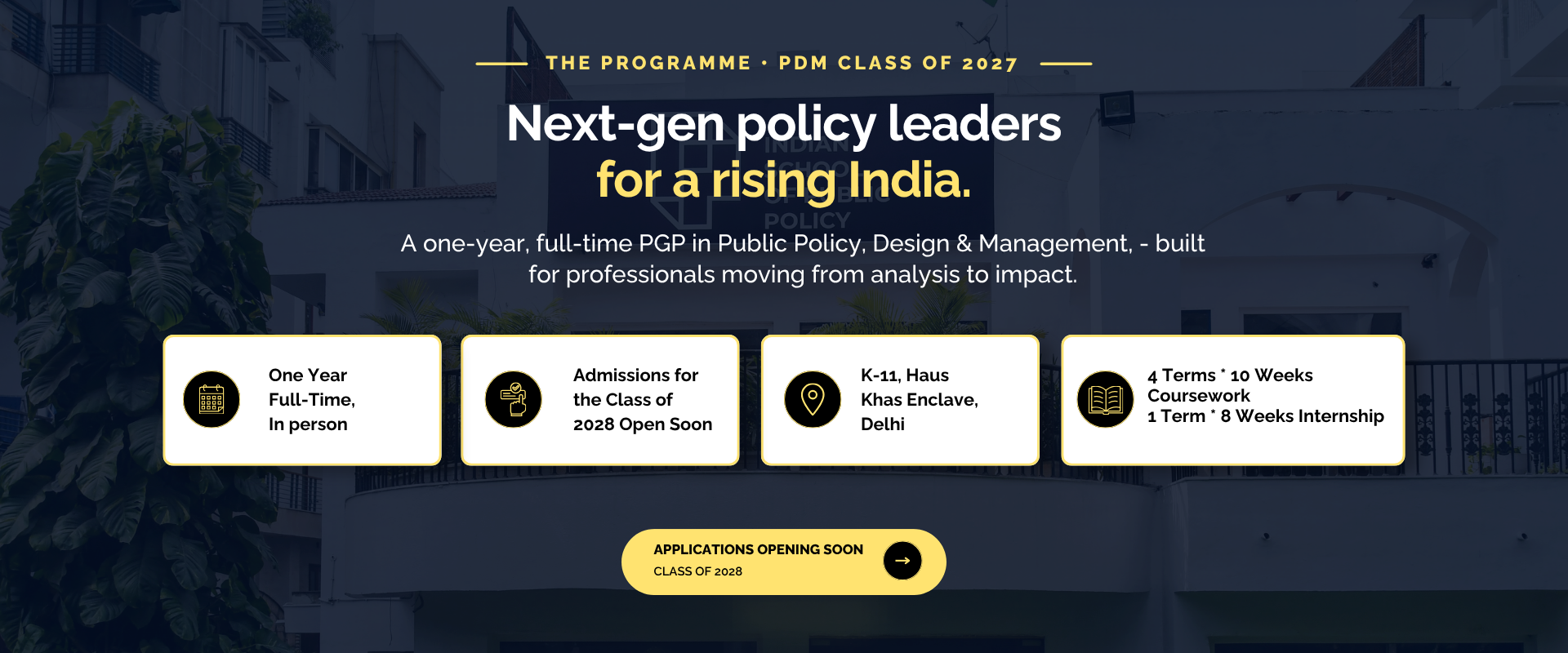
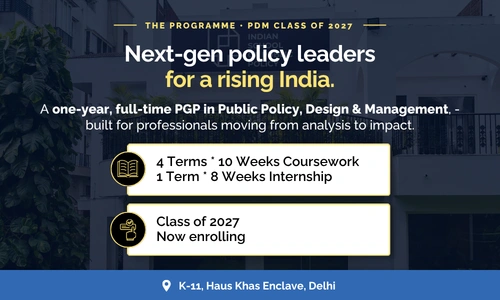
It is a one-year, full-time course with on campus classes for five to six days a week, typically from August to July. It has four academic terms of 10 weeks each and the fifth term of 8 weeks is for internship or an independent study.
Scholars have the option to choose from domains for further studies in Education, Environment, Health, Infrastructure, Technology, and Urbanisation
Opportunity to engage with leaders in the samaj, sarkar, and bazaar in small-group closed-door discussions through Tea and Policy sessions at the campus
Workshops with business leaders, senior bureaucrats, and internationally renowned academicians to impart problem-solving, critical thinking and leadership skills
Scholars get the opportunity to opt for Immersive Learning Experiences where they work with organisations/corporations on live projects and apply learnings from the classroom to solving contemporary policy challenges
Dedicated career support and training with workshops and training sessions by leaders from the corporate and consulting space.
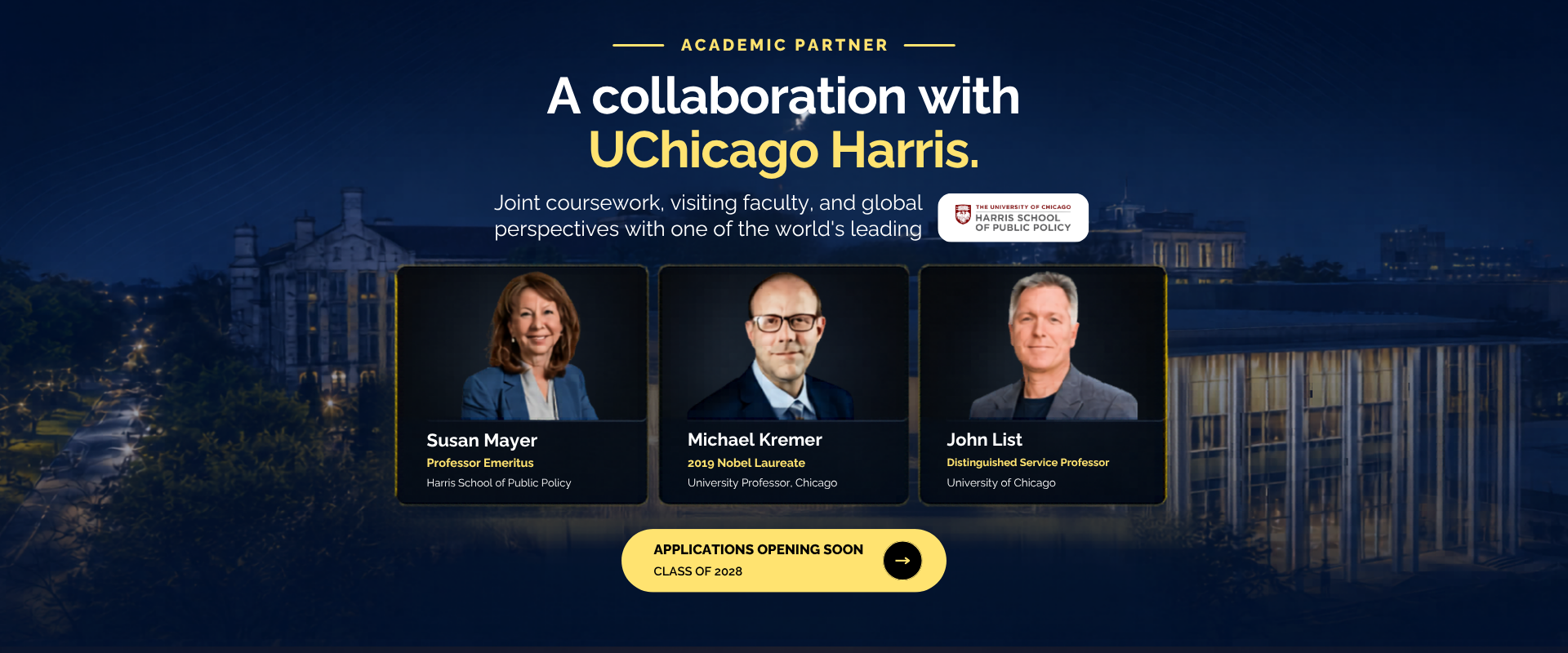
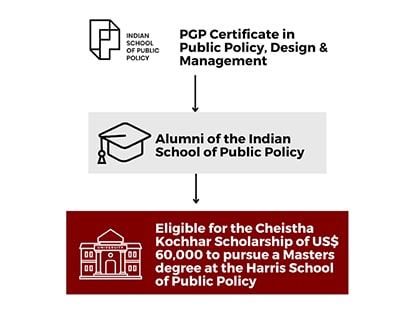
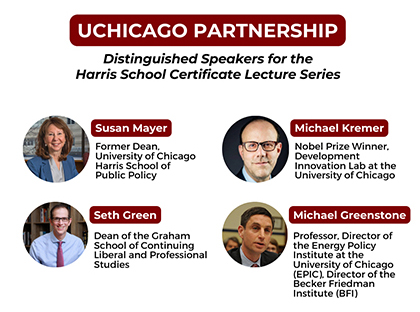
Scholars Journey With The Harris School
Eligibility
A Bachelor’s degree with a minimum aggregate score of 50%
Open to working professionals from any academic or professional discipline
Basic numerical literacy and fluency in English
Demonstrated interest and commitment to public policy & governance.
At ISPP, we believe in a holistic approach to policy, design and management which is based on the five pillars of Skills (S), Political Economy (P), Ethics (E), Leadership (L), and Lifelong learning (L). We have integrated the SPELL framework in designing the curriculum and the overall learning environment at the institution. This is implemented through the courses, mini-courses, workshops and labs, and domains.
This foundational course explores public policy as both an academic discipline and a professional practice. Students learn why societies need policy, how it’s made and delivered, and what it takes to lead reform in real-world governance systems.
Structured into three parts—principles, process, and practice—the course blends conceptual frameworks with Indian case studies, drawing on works by Vijay Kelkar & Ajay Shah and Karthik Muralidharan. Students build core skills in:
Analysing collective action problems
Designing policy in complex, imperfect systems
Reasoning clearly and acting adaptively
Navigating institutions and ethical commitments
It’s the intellectual gateway to your journey as a public policy professional
This course explores how governments function, deliver public goods, and uphold societal well-being. Students examine the structures, staffing, and processes that enable governance, and learn how institutions address collective needs beyond individual interests.
Key learning outcomes include:
Understanding the role and forms of government
Exploring organizational structures and staffing
Examining how governments discharge key functions
Identifying key public institutions and leadership roles
This course explores how society (Samaaj), government (Sarkaar), and markets (Bazaar) interact to address development challenges. Students critically examine market failures and learn to redesign markets to better serve marginalised communities and regions.
Key themes include:
Rethinking the role of markets in public service delivery
The M4P framework: Markets for the Poor, Government, Natural Resources, Failures, and Undefendables
Designing market-based solutions in non-traditional areas like organ transplants and poverty alleviation
Challenging conventional assumptions to build empowering, inclusive markets
This course invites bold thinking and equips students to craft innovative, context-sensitive policy tools.
This course introduces students to India’s regulatory landscape, examining the legal frameworks, institutional powers, and governance mechanisms that shape public policy. Using tools from Law and Economics, students analyse how regulation works in practice—especially in the electricity sector and securities markets.
Key learning outcomes include:
Understanding the rise and role of the regulatory state
Mapping major regulatory agencies and their evolution post-1991
Evaluating the powers, functions, and decision-making of regulators
Assessing accountability mechanisms and transparency frameworks
Comparing regulatory authority with legislative power and its impact on policy
This course explores how economics informs public policy—both in shaping societal behaviour and in allocating limited resources. Students learn to apply economic reasoning to real-world policy challenges, balancing trade-offs and prioritising objectives.
With a blend of theory and application, the course covers:
Where economic thinking supports policy design
Trade-offs, prioritisation, and unintended consequences
System-wide outcomes and stakeholder interactions
Dynamics between consumers, businesses, and government
Active classroom engagement is key to unlocking the full value of this course.
This course examines the strategic dynamics of human interaction, applying analytical tools to economic, political, legal, and social issues. Students explore key concepts like Nash equilibrium, backward induction, credible commitments, and games of incomplete information.
Topics include:
Simultaneous and sequential games
Repeated games and development applications
Trade-offs between self-interest and collective outcomes
Strategy design in auctions, pricing, bargaining, and political competition
Drawing on the work of Nobel Laureates, the course equips students to predict outcomes and craft optimal strategies in complex, real-world scenarios.
This course introduces the fundamentals of macroeconomics and public finance, focusing on how economic systems function and how policy instruments shape outcomes. Students explore fiscal and monetary policy, resource allocation, and the trade-offs involved in public decision-making.
Through Indian case studies, the course builds analytical skills to:
Understand how public policy interacts with the economy
Apply core macroeconomic and public finance concepts
Critically assess real-world policy measures using economic frameworks
This course explores how human decisions are shaped by context, internal motivations, and mental models—often defying the assumptions of rationality in traditional economics. Students learn to identify systematic patterns in irrational behaviour, such as heuristics and biases, and apply these insights to design more effective interventions and policies.
Rooted in Behavioural Sciences, the course equips future policy professionals to tackle complex challenges where human behaviour is central to change.
This course explores the dynamic relationship between business and government, offering economic and political perspectives on issues like trade, environment, food security, and health. Students learn to align market and non-market strategies with public policy, and anticipate how government actions shape business outcomes.
Key topics include:
Market failure and collective action
Governance systems and regulatory dynamics
Role of interest groups and public discourse
Policy impacts on sectors like tariffs, bailouts, and education
The course equips students to navigate and influence policy in complex institutional environments.
This course examines the role of law in achieving social goals through the lens of economics. Students explore the normative foundations of legal and economic principles, and how law generates social value through market-driven transactions.
Topics include:
Economic perspectives on Property, IP, Contract, and Tort Law
The impact of legal compensations, punishments, and regulations
The interplay between legal frameworks and economic outcomes
The course equips students to analyse laws as tools for shaping policy and advancing public interest.
This course builds conceptual clarity and practical skills in using statistical methods for public policy research. Students develop an intuitive grasp of econometric techniques and learn to apply them to real-world datasets.
Topics include:
Sampling, estimation, and hypothesis testing
Comparison of means for policy evaluation
Linear regression and its limitations
Advanced tools like categorical variables, panel data, and causality analysis
The focus is on hands-on data analysis and empirical applications drawn from the public policy domain.
This course introduces the full M&E planning cycle, equipping students to assess and improve policy implementation in complex development settings. Through case studies like Swachh Bharat Abhiyan and Bangladesh’s Urban Health Project, students learn to build robust frameworks using tools like Theory of Change, Logical Frameworks, SMART indicators, and India’s Output-Outcome Monitoring Framework (OOMF).
Key skills include:
Designing and applying M&E frameworks
Data analysis, visualisation, and quality assessment
Evaluation methods: qualitative, quantitative, and mixed
Sampling, survey design, and error identification
Hands-on exercises ensure students gain practical, actionable insights into M&E’s role in effective governance.
Design Thinking is a human-centred, problem-solving approach that goes beyond aesthetics to drive innovation in policy, services, brands, and business models. It helps uncover what people truly need and translate insights into impactful solutions.
This course introduces Design Thinking as a tool for empathy-driven, collaborative innovation—not just for designers, but for anyone tackling complex challenges. Students will:
Explore key principles of user-led design
Apply Design Thinking to a real-world public policy challenge
This course equips students to design and conduct evidence-based policy research, from framing questions to analysing data. Through hands-on exploration of research tools and methodologies, students learn to build a complete research framework.
Key outcomes include:
Evaluating qualitative, quantitative, and mixed-method approaches
Developing research questions and proposals grounded in ethics and literature
Applying data collection and analysis techniques using relevant tools
Ideal for scholars seeking to turn inquiry into actionable insight.
This course introduces Systems Thinking and System Dynamics modelling to analyse complex, real-world challenges. Students learn how feedback loops, time delays, and agent interactions shape development outcomes—and why technology alone often falls short.
Key concepts include:
Interconnectedness and feedback dynamics in social systems
Simulation modelling to test policy interventions
Identifying leverage points through sensitivity analysis
Using computer models to overcome bounded rationality and predict long-term system behaviour
The course equips students to design smarter, more sustainable solutions in complex policy environments.
The Antarang Leadership Lab (ALL) is an immersive, experiential space designed to nurture intimate and impactful leadership among ISPP scholars. Rooted in the spirit of Antarang—meaning “inner” or “intimate”—the lab fosters personal growth through hands-on learning and meaningful dialogue.
Workshops begin with self-awareness and expand into themes like:
Networking and cultural fluency
Teamwork and effective communication
Resilience, success, and leadership presence
The journey culminates in a three-day retreat in the hills, offering space for reflection and renewal.
Scholars are grouped into small, informal squads led by a Squad Facilitator, encouraging close academic and personal exchange. Each scholar is also paired with a mentor—a senior professional who serves as a sounding board for personal and career development throughout the year.
Together, these elements prepare scholars to lead with clarity, empathy, and confidence—at ISPP and beyond.
This hands-on course places the citizen at the heart of policy, bridging theory with grounded action. Students explore how governance unfolds through laws, norms, culture, and infrastructure, and learn to design context-sensitive, actionable policy solutions.
Key elements include:
Curated readings, guest talks, and an 8-week field project
Design-thinking and ethnographic methods
Stakeholder-informed interventions for local spaces
Visual and oral communication of policy ideas
The lab equips students to navigate and shape real-world policy with empathy and insight.
The Writing and Communication Lab sharpens scholars’ ability to engage policy stakeholders with clarity and impact. Through apprentice-style training, it builds verbal, non-verbal, and written communication skills tailored for development, corporate, and academic settings.
The lab offers:
Public policy, academic, and business communication modules
Regular lectures and personalised one-on-one coaching
Collaboration with the Careers team for professional readiness
Scholars learn to craft compelling messages, translate research for diverse audiences, and communicate with confidence across platforms.
The Professional Development Lab (PDL) bridges the gap between classroom learning and real-world policy practice. Over a seven-month journey, scholars gain:
Sector insights across think tanks, government, consulting, CSR, and development
Hands-on skills in project management, policy analysis, and stakeholder communication
Career readiness through resume workshops, mock interviews, and communication coaching
Mentorship and curated networking to build confidence and clarity in career pathways
PDL equips scholars with the skills, mindset, and networks to thrive in diverse public policy roles.
The Education Domain at ISPP is strategically designed to deepen scholars' understanding of the educational sector's challenges through a socioeconomic perspective. This domain aims to empower scholars to formulate thoughtful policies by considering the intricate complexities and real-world difficulties faced in education. The curriculum specifically focuses on themes that resonate with scholars interested in this domain, covering critical issues such as the financing of education (private vs. public funding), the role of technology in enhancing educational delivery, the unique challenges faced by the poor and other marginalised groups, and the intersections of education with employment and skill development. This targeted approach ensures that scholars are well-prepared to effectively address and influence educational policies, considering both broad societal impacts and specific stakeholder needs.
This domain introduces scholars to key contemporary issues in environmental policy and governance. It provides an overview of the importance of environmental issues in economic and social policy, the role of regulation and markets in solving environmental problems, relevant approaches and instruments, and the regime of environmental laws and governance in India. Specific environmental problems, such as climate change, pollution, forests & biodiversity, and the associated strategies for addressing them from national and international perspectives are dealt with.
The Health domain covers various crucial topics to understand and address health issues through policy frameworks. Initially, discussions focus on health's importance in public policy, assess India's current health status, and explore Universal Health Coverage. Later sessions will delve into the Social Determinants of Health, the impact of the Environment on Health, and Public Policy concerning Tobacco and Alcohol. Future topics will broaden the scope to include Pharmaceutical Policy, Digital Technologies for Health, and strategies for managing Infectious and Non-Communicable Diseases, including Mental Health. Additionally, the course will examine policies related to Nutrition, Reproductive, Maternal, Neonatal, Child, and Adolescent Health, and scrutinise the Governance and Regulation of Health Services across various levels of care. Special attention will be given to the Health of Vulnerable Populations, ensuring a comprehensive understanding of how public policy can enhance health outcomes across diverse demographics.
The infrastructure domain is designed to introduce the broad, complex, and rapidly evolving canvas of public infrastructure in the country, through a focused study of policy planning, financing, and execution of large infrastructure projects. With direct experiential learning at its core, teaching inputs are drawn from government policy documents and strategic action points for infrastructure delivery including Contracts and Concession Agreements. Academic inputs also cover the areas of Public Private Partnerships, Development Finance Institutions and Regulation and Oversight of Infrastructure delivery. Fast learning outcomes are envisaged through case studies, hands-on project planning templates, and tool kits. Due to its very nature, the Infrastructure domain has multi-disciplinary teaching inputs that are useful across the policy spheres of economic planning, public finance, and public procurement.
The Technology domain offers scholars a comprehensive overview of navigating and balancing stakeholder interests in digital communications and technologies, focusing on a consumer-centric perspective. Scholars will gain valuable insights into formulating policies that prioritise consumer engagement and trust, which are crucial for the successful adoption of digital technologies. The curriculum addresses critical challenges such as inclusion and access, data privacy, competitive practices, and the ethical implications of artificial intelligence, highlighting their importance in both global and Indian contexts. Through the technology domain sessions, students will delve into contemporary issues surrounding Consumer Protection in the Digital Era, exploring how to effectively balance considerations of inclusion, competition, privacy, data protection, and ethics in AI, ensuring that technology policy-making aligns with the broader interests of all stakeholders involved.
The urbanisation domain is designed to engage scholars deeply with the multifaceted aspects of urbanisation, particularly within the Indian context. The objective is to expose students to a broad spectrum of urban issues, fostering a comprehensive analysis of policy concerns and strategies pertinent to the urban sector. Scholars will explore the full scope of public policy and enhance their skills in debating, developing strong arguments, and presenting their ideas effectively. Each session concentrates on specific urban policy issues like housing, mobility, and financing. The course culminates with scholars tasked with designing a detailed plan or policy for a city of their choice, aiming to outline potential growth and development through strategic public policy interventions. This approach broadens understanding and equips scholars with practical urban policy planning and implementation skills.
Admission Process
Application
Register on the ISPP Admissions Portal
Submit Details
Upload Documents
Selection
The PDM programme has a three-stage selection process:
Find answers based on your career goals and persona:
The Aspiring Researcher
Idealistic Recent Graduate
The Public Sector Aspirant
The Development Professional
The Corporate Strategist
The Academic Aspirant
Yes. ISPP is specifically designed for students who want to build strong research capabilities and apply them directly to policymaking and institutional decision-making.
Unlike a traditional corporate MBA or a purely academic degree, ISPP sits between the two worlds—combining academic rigour with real-world direction. We prepare you for these roles through:
Evidence-Based Curriculum: You will master analytical tools such as economics, statistics, policy analysis, and governance frameworks. This approach is reflected in ISPP’s overall academic structure of the programme and philosophy of public policy education.
Applied Research: Through the Policy Praxis Lab, you will work on real-world policy problems, turning research into actionable solutions.
Expert Faculty: You will learn from a mix of economists, policy researchers, and former senior government officials who bring lived policy experience to the classroom. ISPP’s faculty
Strategic Career support: Our structured career development framework is designed to move students into think tanks, government bodies, and consulting firms where research skills are essential.
The ISPP Philosophy: Research is our foundation, and policy impact is our goal. We have a dedicated research ecosystem at ISPP and knowledge platforms that reinforce its research orientation, such as its research ecosystem and thematic policy centres.
ISPP is application-driven. While a corporate MBA focuses on profit and a research degree focuses on theory, ISPP focuses on impact.
You will spend 50% of your time mastering rigorous tools like Economics and Statistics (Research) and the other 50% using those tools to solve real-world governance challenges through the Policy Praxis Lab, (Application).
Yes. At ISPP, you don’t just study policy—you practice it. We provide three distinct platforms for real-world application:
The Policy Praxis Lab,: This is the core of our "Learning by Doing" philosophy. You will work on live projects, often in collaboration with external partners, to solve actual governance challenges.
The Policy Hub: A dedicated platform for students to publish articles, thought leadership pieces, and data-driven policy analysis. This helps you build a public professional portfolio before you graduate.
Thematic Research Centres: You can engage with ISPP’s specialised research centers that focus on specific domains like urban tech, state capacity, or economic policy, giving you access to real-world policy data.
The Result: You graduate with a "Portfolio of Practice" rather than just a transcript of grades
Absolutely. ISPP is committed to turning scholars into thought leaders. We provide structured platforms to ensure your research reaches a wider audience:
Writing and Communication Lab: This lab is dedicated to honing your ability to draft high-impact policy briefs, white papers, and op-eds. You will learn to translate complex data into compelling narratives for stakeholders and the public.
Policy Praxis Lab: Through this lab, you engage in real-world policy research. The briefs and reports you generate here often serve as the basis for professional policy documentation.
Scholarly Blogs & The Policy Hub: We actively encourage and mentor scholars to write and publish blogs. Our Policy Hub serves as a digital showcase for your analysis, helping you build a public portfolio of published work before you even graduate.
While a traditional Master’s degree is often academic and theoretical, ISPP’s PDM is a professional, practitioner-led program. The key differences are:
Pedagogy over Theory: Universities often focus on "learning about" policy through textbooks. At ISPP, you focus on "how to do" policy. Our curriculum is designed by practitioners to meet the current demands of the policy ecosystem.
The Policy Praxis Lab: Unlike most university programs, ISPP includes a mandatory residency in the Praxis Lab, where you work on live projects for real clients (government, NGOs, or think tanks) instead of just writing a final thesis.
Industry Integration: Our faculty consists of former IAS officers, economists, and industry leaders who bring "lived experience" to the classroom, whereas universities primarily feature career academics.
Career Acceleration: A university degree provides an academic credential; ISPP provides a professional launchpad. Our Career Support Cell is specifically built to bridge the gap between education and high-impact employment in the policy world.
ISPP is suitable for students who want a strong research foundation before pursuing a PhD or fellowship. Its academic structure and research ecosystem support analytical depth and policy research exposure, though it is primarily an applied policy programme rather than a pure research degree.
Absolutely. A large part of our cohort consists of fresh graduates from diverse fields like engineering, law, and humanities. We don’t expect you to be a policy expert on Day 1; we expect you to be curious.
How we bridge the gap for you:
The 3-Week Bridge Course: Before the main program begins, all scholars attend a dynamic foundational program. This acts as a vital stepping stone, bringing everyone onto the same page by laying a strong foundation in Public Policy, Economics, Statistics, and Data Analytics.
"Learning by Doing" through Specialised Labs: You won’t just study theory; you will practice it in our interactive labs:
Writing and Communication Lab: This lab sharpens your ability to engage stakeholders by honing your policy writing, public speaking, and presentation skills.
Antarang Leadership Lab: Focused on self-awareness and leadership, this lab helps you build the soft skills and resilience needed to lead in complex environments.
Policy Praxis Lab: Here, you tackle real-world case studies and hands-on exercises to learn how to design solutions that serve diverse public interests.
Professional Development Lab: This lab focuses on the ethics and professional behaviors that make our scholars "Day Zero" leaders in their careers.
Career Discovery: Our Career Support Cell doesn’t just find you a job; they help you discover your niche—whether it’s tech policy, social justice, or climate change—based on your unique strengths.
Yes, many ISPP scholars join with a passion for change but unclear career paths. We provide a structured "Navigation System" to help you move from a general interest in "impact" to a specific professional role.
The Sarkaar-Samaj-Bazaar Framework: We help you map your interests across the three pillars of the policy ecosystem so you can see where you fit best:
Sarkaar (Government): Working within ministries, state units, or as a consultant to government bodies.
Samaj (Civil Society): Impact-led roles in high-profile NGOs, global foundations, and grassroots organisations.
Bazaar (Markets/Private Sector): Careers in Corporate Affairs, ESG, Sustainability, and Policy Consulting within the private sector.
How we guide your discovery:
Professional Development Lab : Unlike academic classes, this lab is dedicated to your personal evolution. It helps you identify your core strengths—whether you are a "Data Cruncher," a "Strategic Communicator," or a "Field Leader"—and aligns them with specific career tracks.
Career Readiness: You will participate in intensive resume workshops, mock interviews, and communication coaching to ensure you are ready for the job market.
Practitioner Mentorship: You are paired with a Senior Industry Mentor who acts as a sounding board. Through these 1-on-1 interactions, you get an unvarnished look at the day-to-day life of professionals in different sectors.
Tea & Policy Sessions: These informal interactions with visiting experts, alumni, and policy leaders allow you to "test-drive" different career paths by hearing first-hand about the challenges and rewards of their roles.
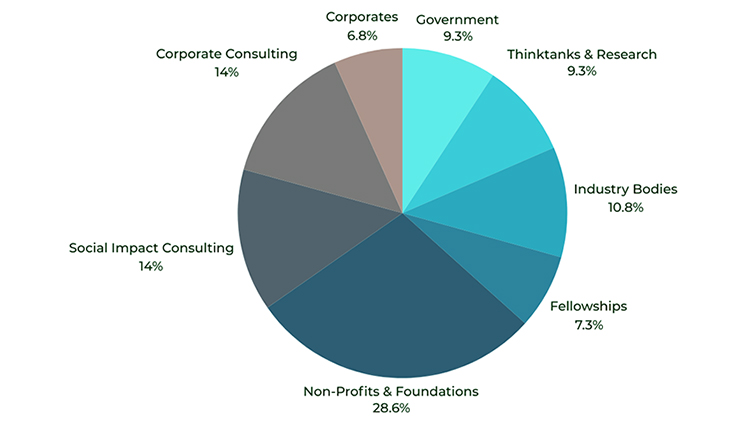
Recent ISPP graduates secure diverse entry-level roles in government, NGOs, think tanks, industry bodies, and academia (see Careers page). Common positions include policy associate, research assistant, programme coordinator, consulting analyst, and project officer. These leverage your analytical and governance skills in real-world policy settings.
No, prior work experience is not mandatory. ISPP's structured Career Development Journey supports all students—fresh graduates included—with mentoring, skill-building workshops, and personalized guidance. Everyone gets equal opportunities to grow into impactful policy roles.
Most people assume the only way to work in government is through the civil service exams. ISPP prepares you for the "Professional Lateral Path." We train you to be the specialised expert—the consultant, the researcher, or the analyst—that modern government departments now rely on to function.
Mastering the "Sarkaar" (Government) Pillar:
The Technical Toolkit: We move beyond theory to teach you the "hard skills" of administration. You will dive deep into Public Finance, Regulatory Design, and Legislative Drafting. You won't just study laws; you will learn how to draft them and how to manage the budgets that fund them.
Bureaucratic Intelligence: Our faculty includes former IAS officers and senior advisors who have run the system. They don’t just teach from textbooks; they provide an "insider's view" on how decisions are made in high-stakes environments and how to navigate the complexities of State Capacity.
Data-Driven Governance: Modern government roles—such as those in NITI Aayog, State PMUs, or CM Fellowships—demand evidence. We equip you with the Data Analytics and Policy Evaluation skills needed to prove which programs are working and why.
Immersive Learning Projects (ILP): You will spend a significant part of the year working on live projects, often directly for government bodies or organizations working closely with them. This is your "residency" in public administration, giving you hands-on experience before you even graduate.
The Result: You don’t graduate as an observer; you graduate as a practitioner. You enter the workforce ready for high-impact roles as Policy Consultants, Program Managers in PMUs, and Strategic Fellows in various state and central government initiatives.
UPSC is about becoming the system; ISPP is about working inside the system as a policy professional. While UPSC is exam-oriented, ISPP is skill-oriented, focusing on public finance, data analysis, and program implementation.
Yes,While we do not promise government "postings," we prepare you for professional roles (associates, analysts, consultants) that ministries and departments now hire to manage research and program evaluation.
Yes. Many policy roles involve collaboration with government officers, ministries, and public sector institutions. As highlighted under Careers in Public Policy, graduates can work as policy associates, research analysts, or consultants who support IAS officers and
Many development professionals reach a plateau where they have immense "ground truth" but lack the frameworks to influence systemic change. ISPP is designed to help you pivot from "doing" to "designing."
From Execution to Strategy: We help you translate your implementation experience into policy-speak. You will learn to frame field problems as policy challenges, using tools like Public Finance, Cost-Benefit Analysis, and Impact Evaluation.
The Professional Development Lab (PDL): We work with you to rebrand your professional narrative. We shift your profile from "Field Manager" to "Policy Architect," preparing you for leadership roles in think tanks, funding agencies, and international NGOs.
Bridging the Gap: Through the Policy Praxis Lab, you can take a lead role in projects that require a deep understanding of grassroots reality, proving your ability to manage both the "top-down" strategy and "bottom-up" implementation.
The Result: You don’t leave your field experience behind; you leverage it. You graduate with the institutional legitimacy to transition from managing programs to advising on the policies that create them.
Field experience is the "soul" of policy, but data is the language spoken in boardrooms and ministries. ISPP doesn't ask you to leave your ground-level insights behind; we give them "analytical teeth."
Validating the "Gut Feeling": You already know what works on the ground. We provide the Economics and Statistical tools to prove why it works using hard evidence. This is the difference between an observation and a policy recommendation.
The Writing and Communication Lab : We help you translate complex field narratives into concise, data-driven Policy Briefs and White Papers. You will learn to write for an audience of donors, bureaucrats, and global leaders who value brevity and evidence.
Peer-to-Peer Learning : You won't just learn from faculty. You will be in a cohort with researchers, lawyers, and engineers. This diversity forces you to defend your field-level assumptions against different professional perspectives, sharpening your advisory skills.
To scale impact, you need more than just a good idea; you need Institutional Access. ISPP is built on a network that connects you directly to the movers and shakers of the "Samaj" (Civil Society),"Sarkaar" (Government) and “Bazar”( Market)
Practitioner-Led Faculty: You aren't just learning from academics. Our faculty and visiting scholars include former IAS officers, advisors to the World Bank, and leaders from global foundations. These aren't just teachers; they are your first professional gateway to those networks.
Senior Industry Mentors: You are paired with a veteran from the development or policy space. This mentorship isn't just for advice; it’s about understanding the "hidden rules" of navigating careers in multilaterals (like the UN or UNDP) and large-scale funding agencies.
The Career Support Cell: Our team works specifically to map your prior experience to high-level roles in impact consulting, philanthropic foundations, and multilateral advisory units ensuring your "years on the ground" are leveraged as a premium asset.
Many corporate professionals feel "boxed in" by the execution-heavy nature of CSR. ISPP helps you break that ceiling by shifting your focus from project management to systemic analysis.
From "Doing" to "Designing": We don't just teach you how to spend a CSR budget; we teach you how to analyze the regulatory environment that dictates it. You will master Regulatory Design, Economics, and Public Finance—the building blocks of strategy.
Building Credibility: To be seen as a policy professional rather than just a "CSR person," you need a new vocabulary. ISPP provides the academic and institutional legitimacy to pivot into high-stakes roles in Corporate Affairs, ESG Strategy, and Public Policy Consulting.
The PDL Edge: In the Professional Development Lab (PDL), we help you translate your corporate "corporate-speak" into the nuanced language of policy, ensuring your business acumen is seen as a strategic advantage by policy-makers.
Your corporate experience is a massive asset. In the Bazaar (Markets) pillar of our framework, we recognize that the private sector is a primary driver of policy change today.
Applied ESG Projects: Through Immersive Learning Projects (ILP), you can work on live policy challenges that intersect with sustainability, climate tech, and social impact. This allows you to apply your corporate discipline to systemic public problems.
The Quantitative Edge: Corporate professionals often have a head start in data. We sharpen this further in our Quant Lab, teaching you how to use that data for Impact Evaluation and Cost-Benefit Analysis—skills that are critical for modern ESG and sustainability leaders.
Sustainability as Policy: We bridge the gap between "Corporate Sustainability" and "Public Sustainability Policy," showing you how global regulations (like carbon credits or supply-chain ethics) impact the bottom line.
The "Sarkaar-Samaj-Bazaar" framework is designed exactly for this. We help you leverage your understanding of the Bazaar (Markets) to become a valuable consultant for the Sarkaar (Government).
Repositioning Your Profile: The Career Support Cell specializes in "rebranding" professionals. We help you map your corporate project management or financial skills to roles in Multilateral Agencies (UN, World Bank) or Government-facing Consulting (The Big Four).
The Practitioner Network: Through Practitioner Mentorship, you will be paired with veterans who have made this exact leap—moving from corporate leadership to advisory roles in government or global think tanks.
Networking for the Pivot: Our "Tea & Policy" sessions and alumni network connect you with professionals in Public Affairs and Philanthropic Foundations, opening doors that are usually closed to those outside the policy circuit.
Most global top-tier schools (like Harvard Kennedy School or LSE) look for a specific "analytical maturity" that many undergraduate degrees don’t provide. ISPP’s curriculum is benchmarked against these global standards to ensure you aren't just a student, but a scholar.
The Foundational Analytical Core: We build your "academic muscle" through intensive modules in Public Finance, Game Theory, and the Economics of Public Policy. You won't just study these as subjects; you will learn to apply these frameworks to solve systemic governance problems.
Methodological Depth: Our training covers the full spectrum of Policy Evaluation and Research Methodologies(qualitative, quantitative, and mixed methods). This ensures you enter an international classroom already proficient in the data-driven reasoning and evidence-based implementation that global admissions committees prioritize.
Global Benchmarking: The PDM program focuses on Systems Thinking and Design Thinking, ensuring your academic profile aligns with the interdisciplinary expectations of world-class policy institutions.
A strong application needs "Proof of Work." We help you move beyond a standard CV to a Scholarly Portfolio that demonstrates your intellectual contribution.
The Policy Hub & Research Centres: You can publish your analysis on our Policy Hub or collaborate with our specialized research units, such as the Centre for Universal Health Assurance (CUHA) or the Centre for Urban Transitions (ICUT). Having published research or policy briefs is a significant "green flag" for admissions.
Immersive Learning Projects (ILP): Your ILP serves as a significant piece of applied research. It provides a "case study" you can discuss in your Statement of Purpose (SOP) to prove you understand the real-world application of theory.
Writing & Communication Lab: We provide apprentice-style training to help you hone your Academic Writing. You will learn to draft high-impact policy briefs and white papers that meet international scholarly standards.
Yes. One of the biggest hurdles for global applications is securing strong, credible Letters of Recommendation (LORs).
World-Class Faculty: Our faculty includes PhDs and practitioners from the world’s leading universities. An LOR from a professor who understands the global academic standard carries significant weight.
The Professional Development Lab (PDL): In the PDL, we help you curate your academic narrative. We assist in refining your Statement of Purpose (SOP), ensuring that your transition from your undergraduate degree to your future goals is coherent and compelling.
Alumni Network: You gain access to ISPP alumni who are currently studying at or have graduated from top global schools. They provide peer-mentorship on everything from scholarship applications to campus life.
Have some questions related to public policy admissions? Find your answers in the Admissions FAQs as follows:
ISPP’s one-year post-graduate program is your launchpad into public leadership. Learn from world class faculty, former IAS officers, and experts from the Ministry of Finance and NITI Aayog. Build real-world skills, earn a dual credential with UChicago Harris, and access scholarships, internships, and dedicated placement support.
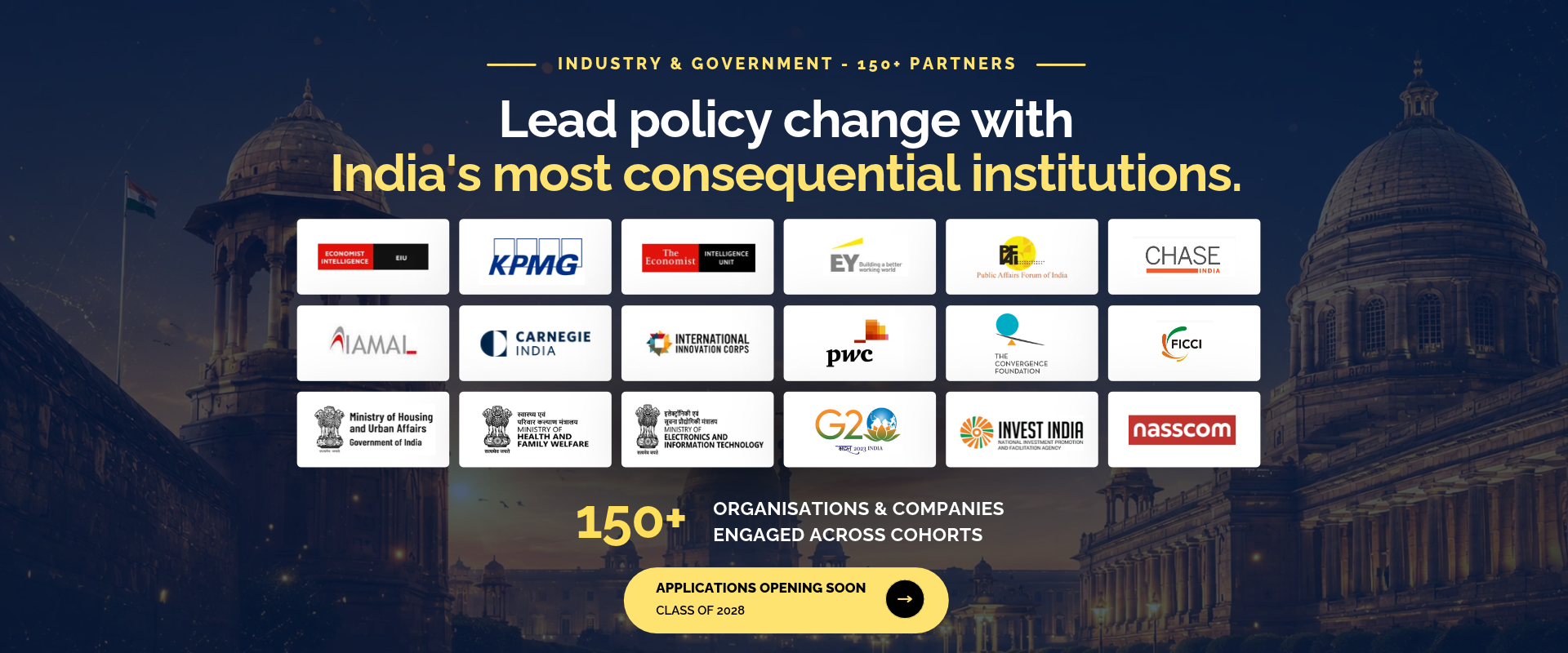
Join a powerful network of changemakers across government, consulting, and development—and start making impact from day one.
ISPP’s one-year, full-time PDM programme trains individuals in the science of policymaking through a rigorous, hands-on curriculum. The academic year is divided into four 10-week terms of coursework, workshops, and labs, followed by a fifth term dedicated to independent study and internship.
Scholars culminate their learning with a Capstone Exercise, solving contemporary policy challenges through original, actionable solutions. Alongside academic training, the programme offers networking opportunities, access to professional forums, and comprehensive career and placement support.
Unlike traditional two-year master’s programmes, ISPP’s one-year format is designed for intensity, agility, and early career entry. The curriculum is rigorous and hands-on, equipping scholars with essential policy, design, and management skills in a compressed timeframe.
As an independent institution, ISPP has the flexibility to adapt its curriculum swiftly—ensuring relevance to real-world challenges and responsiveness to the evolving policy landscape. The result: a high-impact learning experience that prepares you to lead change, faster.
The ISPP Postgraduate Programme is designed as a non-residential experience. While the campus does not offer housing facilities, the Admissions Team supports outstation scholars by sharing accommodation leads and insights from past cohorts.
However, ISPP does not take any responsibility for the price, contract, or quality of services provided by the residential facility that scholars may choose. Each scholar shall sign an individual and independent contract with their agreed residential facility.
Yes—ISPP offers dedicated placement assistance through its structured ‘3-Es towards Employment’ framework, helping scholars translate their skills and domain expertise into meaningful careers.
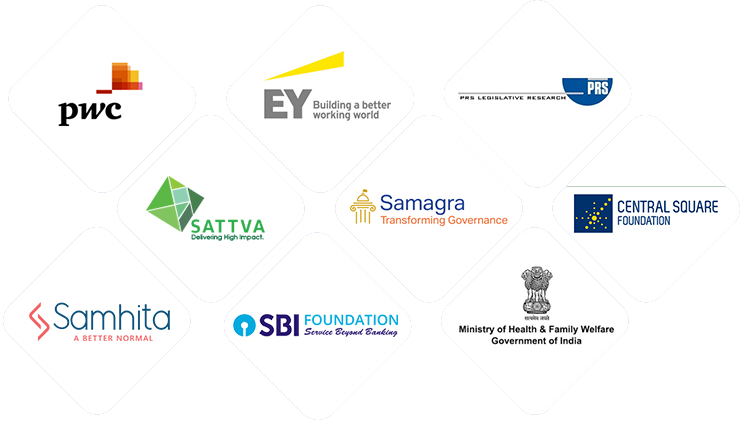
Over the past three cohorts, ISPP scholars have joined leading institutions such as E&Y India, the Ministry of Health and Family Welfare, SBI Foundation, The Economist Intelligence Unit, and the LAMP Fellowship. Those pursuing further studies have secured admissions to top global universities including Oxford, Georgia Tech, and the University of Amsterdam—supported by ISPP’s distinguished faculty and personalized guidance.
Your application is your opportunity to demonstrate clarity, motivation, and readiness for the programme. Please ensure that all sections are filled accurately, and that scanned documents are clear and legible for the Selection Committee.
The Statement of Purpose (SOP) is a key component of your application. Use it to reflect on the following:
Why public policy: What draws you to this field, and why it matters to you
Why ISPP: What aspects of the programme, pedagogy, or community resonate with your goals
Your career goals: What you hope to pursue after completing the programme
Your preparation: How your academic, professional, or lived experiences have shaped your interest in policy
A well-structured SOP helps the Admissions Committee understand your journey, your aspirations, and your fit for ISPP’s learning environment.
Admission to ISPP is based on the Policy Aptitude Index (PAI)—a two-part assessment designed to evaluate your analytical skills, communication ability, and motivation for public policy:
Part A: An online written test covering Quantitative Aptitude, Logical Reasoning, and English Proficiency
Part B: A personal interview with ISPP faculty and alumni to explore your perspective, potential, and fit for the programme
This process helps us identify curious, committed individuals ready to lead change through policy.
The ISPP Bridge Course is a dynamic four-week foundation programme designed to help incoming students hit the ground running. Regardless of prior academic background, it ensures that everyone starts the semester on the same page.
Through engaging sessions in public policy, economics, statistics, and data analytics, students build the core skills and confidence needed to thrive in ISPP’s rigorous postgraduate programme.
It’s more than preparation—it’s a launchpad for your policy journey, equipping you with the tools to think critically, collaborate effectively, and lead with purpose.
Total Programme Fees: ₹9,40,000 (+18% GST)
Admission fee: ₹1,00,000 (+18% GST)
Tuition fee: ₹8,00,000 (+18% GST)
Security deposit: ₹20,000 (refundable; GST not applicable)
Development & Alumni Fee: ₹40,000 (+18% GST)
*Graduate Assistantships are available on a need-cum-merit basis for deserving candidates.
Most nationalized banks, including IDFC First Bank, HDFC Credila, and Axis Bank, offer education loans to ISPP scholars. Additionally, ISPP has partnered with GrayQuest, an education finance company specializing in student EMI options, providing greater financial flexibility for fee payments.
ISPP also offers Graduate assistantships ( Financial assistance) on a need cum merit basis to deserving candidates, demonstrating its commitment to public policy inclusion.
ISPP offers financial support through the Graduate Assistantship programme based on need and merit and the Franklin Templeton Scholarship specifically for women applicants.
The Graduate Assistantship provides financial aid along with hands-on experience, while the Franklin Templeton Scholarship is a dedicated scholarship for women from Tier-2, Tier-3, and Tier-4 cities.
Fee payments can be made through the payment gateway on your applicant dashboard using any of the following modes: Wire Transfer (IMPS, NEFT, RTGS), Credit Card, Debit Card, UPI, Cheque, or Demand Draft.
Please note that any transaction charges levied by the payment gateway are to be borne by the applicant, in addition to the programme fee. Payments must be received in ISPP’s bank account by the stated deadline during office hours. ISPP does not accept cash payments or collect fees on campus under any circumstances.
Fee Refunds, applicable only on the tuition fee component, will be made up to 15 days after the commencement of the programme orientation week, based on the rules prescribed as under:
Refund of Tuition Fee
Time of Withdrawal of Admission
100%
30 days or more before the programme orientation date
75%
Less than 15 days before the programme orientation date
50%
On the first day of the programme orientation week
25%
Upto 15 days after the first day of the programme orientation week
0% or No Refund
More than 15 days after the first day of the programme orientation week
No requests for fee refunds shall be entertained under any circumstances, should a scholar choose to withdraw their enrolment from the programme 15 days after the first day of the programme orientation week.










 Application
 Selection
 Final Admission Offer